When “Closest First” Makes the School Journey Longer
Introduction
The following is a piece of research I’ve been conducting over the last three weeks regarding economic studies that I undertook in my economics undergraduate. I found it interesting that recently there have been many breakthroughs in mathematics driven by AI models, specifically ChatGPT 5.6 and the unreleased version of ChatGPT called Astra.
As an economics student, I have been more inclined to read about and work on tangible problems and have never found that great of an interest in theory. With that being said, I wanted to give AI a shot to work on stuff that I’d already done in my previous undergraduate, to see if any new light could be shed on the mathematics that underpinned what my work was on.
This brought me to my 2nd year work on deferred acceptance. The underpinning of my pretty poorly marked essay was how Northern Ireland decides which children get places at oversubscribed schools. Right now, living nearby only counts as a tiebreaker, so rural children often end up with long, costly bus journeys. If schools have more applicants than places, give a measured advantage to children who live closer, blended with the existing rules like siblings and faith. Because this only tweaks how schools rank applicants and not the matching system itself, the essay argues it keeps the system fair and hard to game, while cutting travel time for rural families. It also argues the change would be cheap, since the Education Authority already collects everyone’s address data.
This is underpinned by the assumption that if schools become more sensitive to proximity weighting, and favour nearby children to a great extent, then total travel time to school will be reduced. This assumption is what we are arguing against here.
I have decided to write the remainder of this essay with AI (with Kimi-K3). This was done to not let my misunderstanding of any of the maths get in the way of the writing, and to have it presented in a clear and direct way.
The short version
Give nearby students priority at a school and, surely, total travel goes down. If a seat is contested and the closer applicant wins it, how could overall distance possibly rise?
It can, and the smallest non-trivial example already shows it.
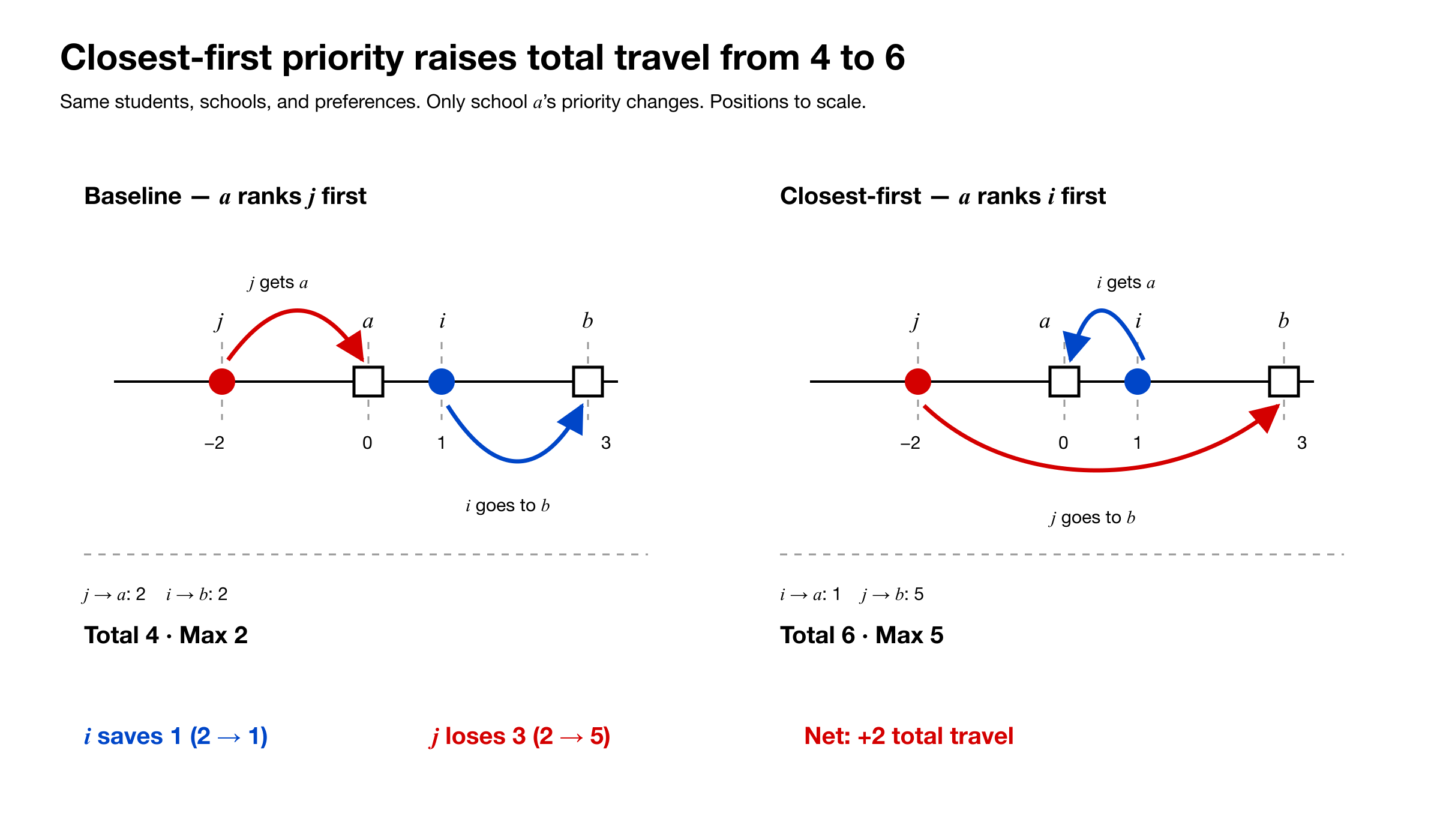
Take two students and two schools on a line. Flip the priority rule from a baseline order to closest-first, and the assignment moves from total travel 4 to total travel 6. The worst individual journey rises from 2 to 5. The student who gains saves one unit. The student who loses pays three more.
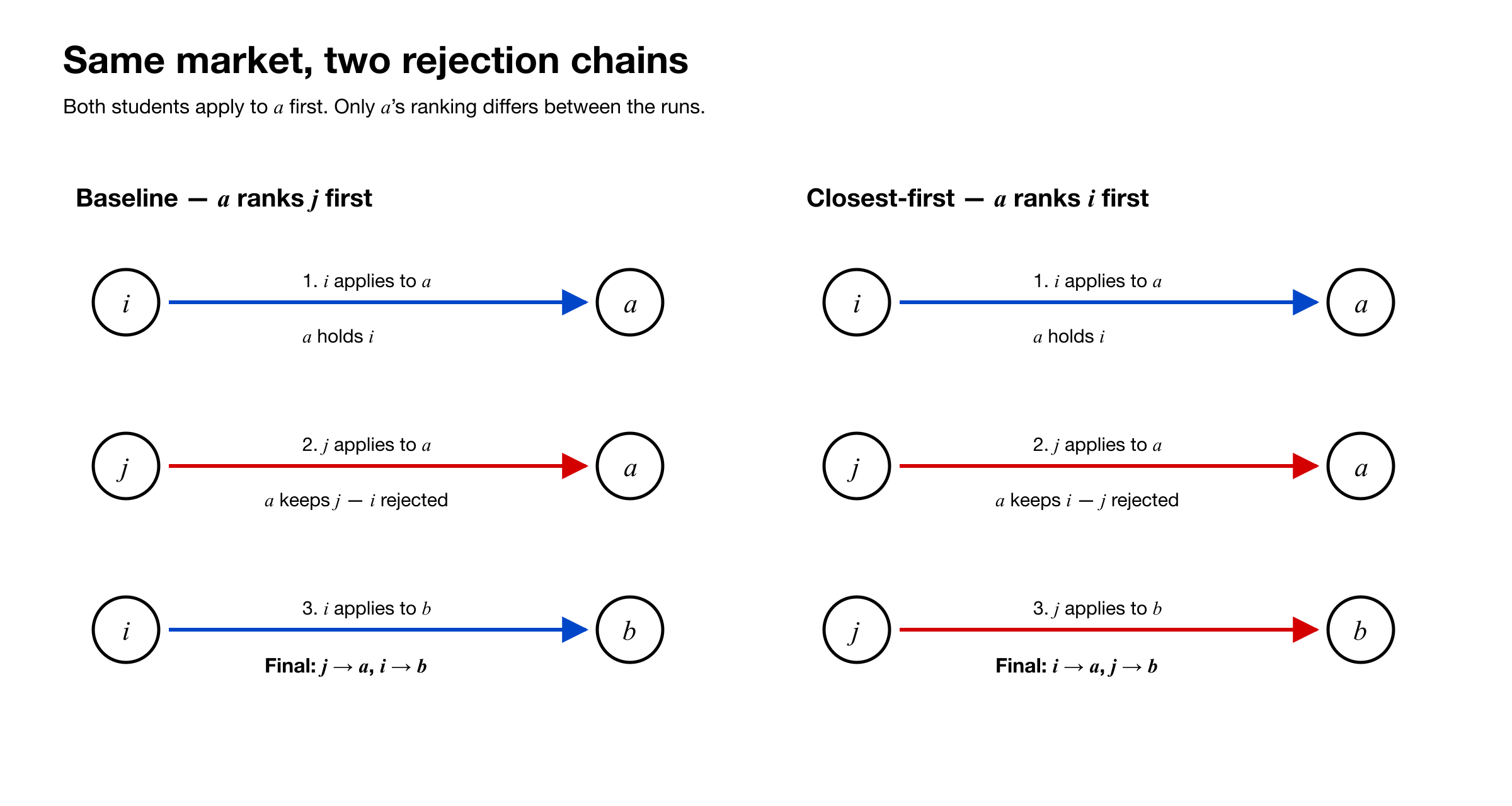
Deferred acceptance is not malfunctioning. Both assignments are stable under the priority rule that generated them. The catch is that stability is an ordinal guarantee and travel is a cardinal quantity. Rewriting the priorities reroutes the rejection chain, and the chain can push someone much farther from home.
A systematic literature review, audited by an independent AI second reader, turned up no materially equivalent prior theorem and no tie-free metric counterexample of this kind. The identity and the witness below are therefore presented as first-known subject to the documented search limits — not as “novelty proved.”
What deferred acceptance guarantees
Student-proposing deferred acceptance (DA) runs most school-choice systems:
Every student applies to their favourite acceptable school.
Each school provisionally holds its highest-priority applicants up to capacity and rejects the rest.
Rejected students move down their list and apply again.
The algorithm stops when no one has an acceptable school left to try.
Given strict priorities, the outcome is stable, and it is the student-optimal stable assignment for that priority profile.
Those last five words carry the whole argument. Swapping a baseline priority order for a proximity-weighted one does not change the answer to one problem; it poses a different stable-matching problem altogether. DA says nothing about how the cardinal distances of the two solutions compare.
The model
Fix the students, schools, capacities, preference lists, distances, and lottery. Only school priorities move.
For school s, write rB(i,s) for a student’s rank under the baseline order and rD(i,s) for their rank under distance order. The project’s main transformation is the scale-free rank score

with lower scores preferred and w running from 0 to 1.
w = 0: baseline priorities.w = 1: closest-first priorities.Exact score ties are broken by a recorded common lottery.
Ranks rather than raw distances keep the rule unit-invariant. A separately labelled sensitivity check uses normalized cardinal distances; it never leaks into the main result.
The smallest counterexample
Two schools and two students on a line:
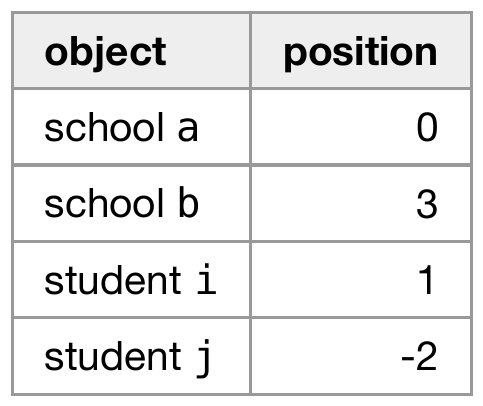
Capacity is one at each school. Both students rank a above b, and those rankings agree with distance:

The baseline puts j above i at both schools. Closest-first puts i above j.
Baseline priority
Both students apply to a. School a holds j and rejects i, who then applies to b.
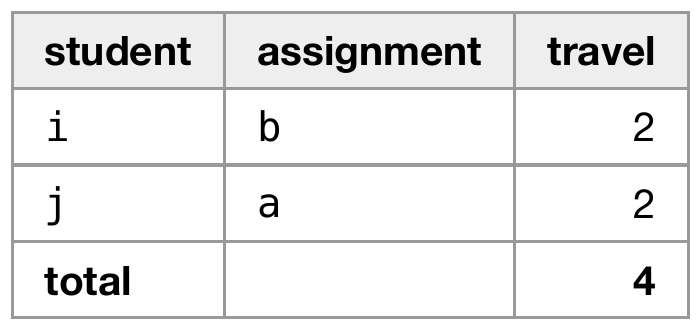
Closest-first priority
Both apply to a again. Now a holds i and rejects j, who falls back to b.
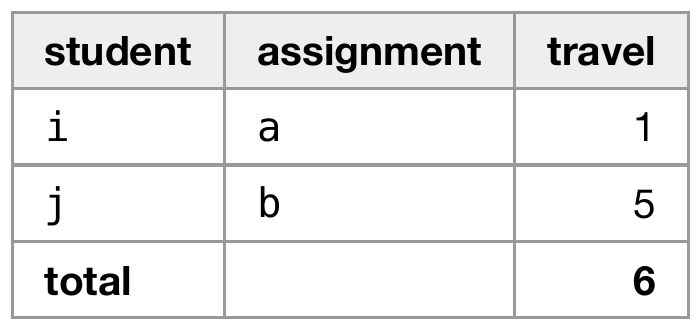
The reassignment is a pure swap: i saves one unit, j loses three. Every student is assigned in both runs, so this is a straightforward before-and-after comparison — not a trick where an unassigned student is counted as travelling zero.
Both outcomes are feasible, stable under their respective priority profiles, and Pareto efficient for the students. Distances are tie-free and the geometry is one-dimensional.
The exact condition
Call student k’s fallback penalty

the extra distance k pays after losing the contested school a and landing at b.
Then the change in total travel is exactly

Proximity priority raises total travel precisely when the displaced student’s fallback penalty exceeds the winner’s saving.
In the example:
Li = 2 - 1 = 1;Lj = 5 - 2 = 3;total change
= 3 - 1 = 2.
Distance-consistent preferences guarantee that both penalties are positive. They say nothing about which one is bigger. That gap is the entire mechanism.
The rank-sum scores at school a expose the threshold:

Student i overtakes j once w > 1/2. At exactly w = 1/2, the recorded lottery settles the tie.
It is not just a two-student curiosity
The effect survives in larger markets.
A tie-free three-student, three-school line-metric witness moves all three assignments and lifts total travel from 11 to 13. The individual changes are (+4, -1, -1): two students come out ahead and one absorbs a larger loss.
Travel can also move non-monotonically as the proximity weight climbs. In a complete four-student, three-school line-metric market with capacities (2, 1, 1), total travel across open weight intervals runs
29 -> 21 -> 29 -> 19.
The middle increase happens strictly inside an open interval between priority-score crossings — it is not a tie-breaking blip at a single weight.
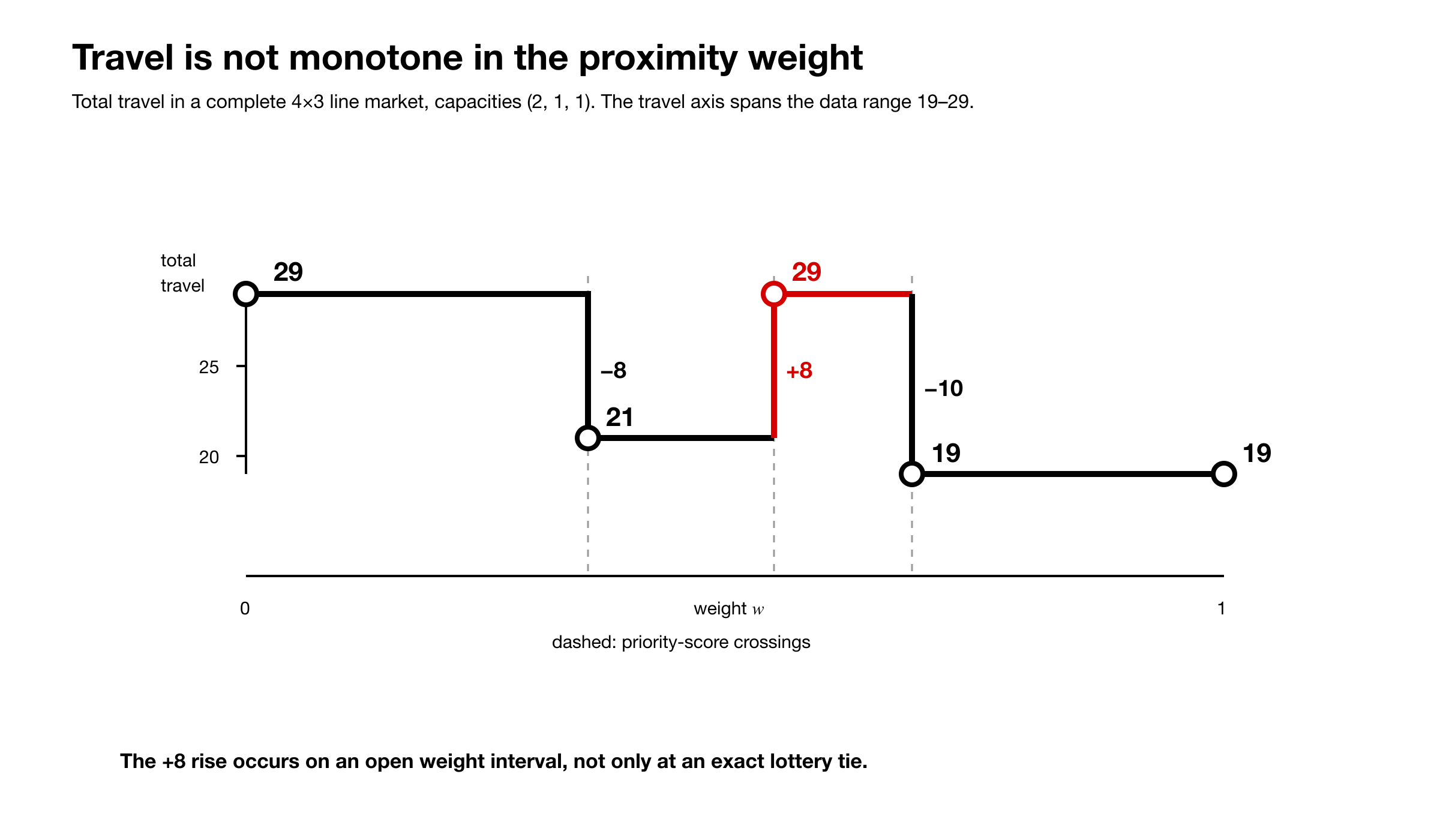
These witnesses matter because comparing only the endpoints can hide what the path does in between.
What the computation says
The repository treats computation as evidence within an explicitly bounded finite domain — never as a population probability and never as an unbounded theorem.
Exhaustive endpoint checks found total-travel increases in every declared domain:

A separate validation run sampled 5,000 markets in each of three geometries and found increases in all three: Euclidean (1,077), Manhattan (799), and shortest-path road networks (628). These are reproducible finite checks, not estimates of how often a real school system will hit the effect.
The implementation also verifies feasibility, stability under each generated priority profile, proposal bounds, queue-order invariance, and agreement with an independently written stable-assignment oracle on the domains where that oracle is enabled.
Three conditions that do prevent an increase
The claim is not “proximity is bad.” The claim is that a guarantee is missing. Several sufficient conditions do rule out an increase.
1. The baseline outcome is stable under the new priorities
If the baseline DA assignment is already stable under the transformed priorities, then transformed DA — student-optimal for those priorities — weakly improves every student’s school in ordinal preference. With distance-consistent preferences and an unchanged assigned set, every student’s distance, the total, and the maximum all weakly fall.
This is a checkable certificate computed from the baseline outcome.
2. First-choice demand fits capacity
If no school’s first-choice demand exceeds its capacity, nobody is ever rejected from their first choice. Priorities never come into play, so rewriting them changes neither the assignment nor travel.
3. Distances are additively separable
If distances decompose as

then, for a fixed assigned set and fixed school occupancy, total travel depends only on who is assigned and how many sit at each school — not on which student occupies which seat. A swap cannot move the total.
A structural result, and a failed conjecture
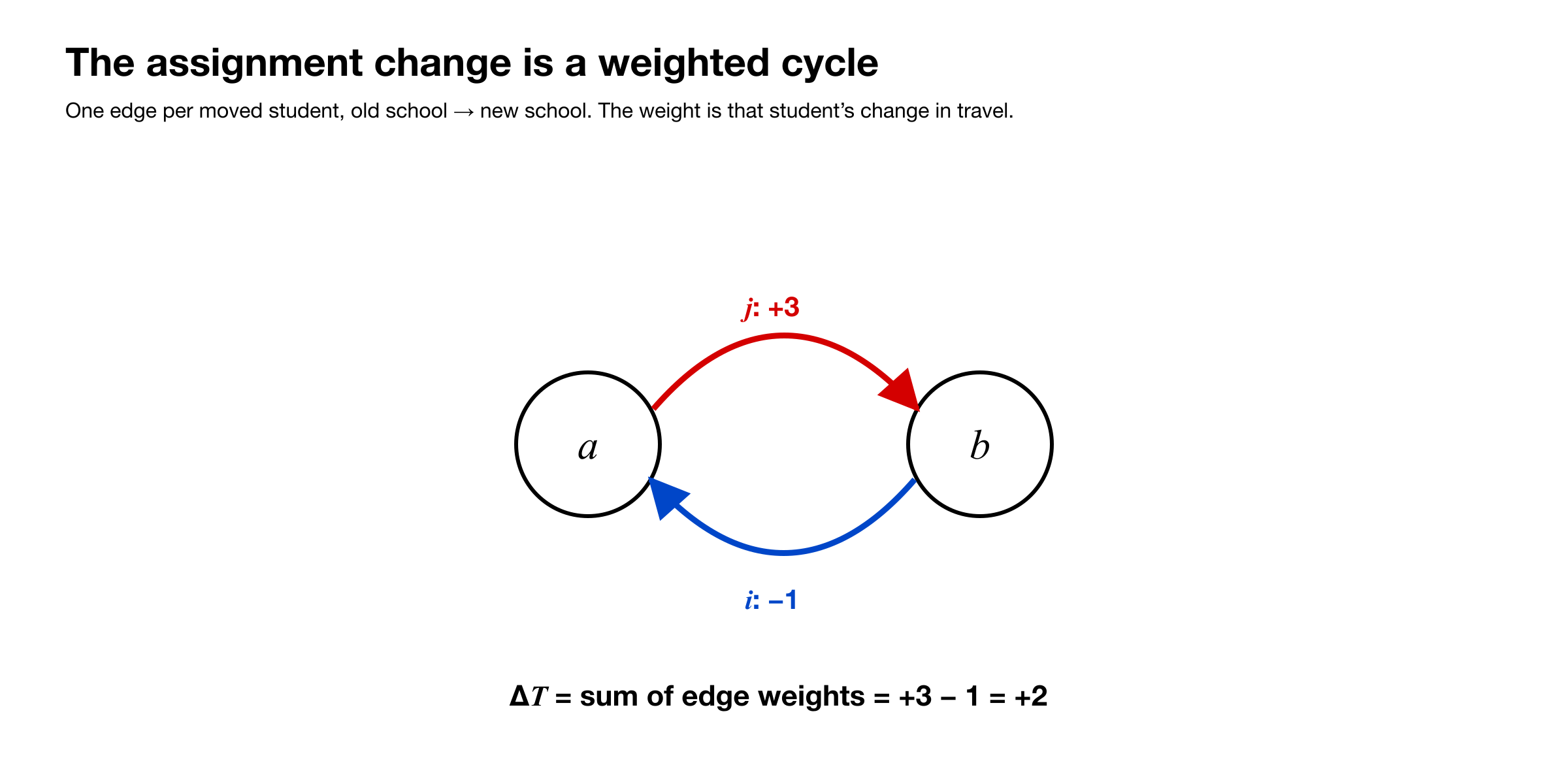
Take two assignments over the same set of students. Draw an edge from each student’s old school to their new one, weighted by that student’s change in distance. Capacities show up as vertex imbalances, so the graph splits into paths and closed trails, and the edge weights sum to exactly the change in total travel.
This is an identity between endpoints. It is not the chronological proposal trace, and confusing the two mattered later.
We conjectured that a single adjacent priority improvement would always yield one final path or closed trail. False. A strict complete-list 4x4 market can produce a connected ten-proposal rejection sequence whose final assignment-change graph consists of two disconnected cycles. The smallest two-component construction needs four students and four vertices with the assigned set fixed; below that, the capacity-aware graph forces a single component.
The companion potential-function result is exact for any sound declared transition graph: a set of school potentials can certify that every allowed closed trail carries non-positive total weight, and feasibility reduces to looking for a positive directed cycle. What remains open is building a materially smaller graph from market primitives that provably covers every reachable movement and every priority-promotion order. That is a live bottleneck, not a solved problem dressed up as one.
What the literature review found
The proof settles whether the effect can occur. The literature review asks a different question: has this exact result appeared before? The two claims must not be conflated.
The review logged 199 query and result-set records across OpenAlex, Crossref, economics indexes, working-paper repositories, publisher sources, broad scholarly search, and two rounds of citation chasing. An independent AI second reader reran 30 queries, read the closest papers in full text, verified the citation seeds, and found neither an exact duplicate nor an unresolved near match.
The three closest sources ask different questions:
Veski and coauthors simulate several finite distance and sibling priority policies under child-proposing DA and report mean distance, but offer no matching monotonicity theorem and no adverse two-student witness.
Shi jointly optimizes menus, priority distributions, and quotas under distance and busing constraints, rather than varying priorities alone in one fixed market.
Çelebi and Flynn optimize score coarsenings in a continuum stable-matching model, rather than comparing two strict finite priority profiles.
Recent work on distance-priority performance bounds, stable matching as optimal transport, relaxed stability, and justifiable priority violations is adjacent too — but it studies ordinal outcomes or modifies the mechanism itself.
The defensible contribution claim is correspondingly narrow:
In the two-student, two-unit-school common-first-choice conflict, the priority-only winner-change identity ΔT = Lj − Li is presented as first-known, subject to the documented search limits.
The strict, tie-free 2x2 unit-capacity line-metric counterexample, with distance-consistent preferences and only priorities changed from a fixed baseline to closest-first, is also presented as first-known subject to those limits.
“First-known” means nothing materially equivalent surfaced in the declared search. It does not assert universal absence from every paper, language, paywall, or desk drawer.
What this does and does not show
This work establishes that:
stable student-proposing DA outcomes need not be ordered by total or maximum travel when school priorities change;
the failure already occurs in a tie-free one-dimensional metric market with distance-consistent preferences;
the exact two-student condition is a displaced fallback loss exceeding the winner’s saving;
larger finite domains and several geometries reproduce the qualitative effect;
local proximity improvements can impose nonlocal rejection-chain costs.
It does not establish that proximity priority usually raises travel, or that it is poor policy in any particular district. The first-known labels are bounded literature-priority claims backed by the dated review and the independent AI audit — not a proof of universal absence.
Real systems layer on reserves, sibling priorities, walk zones, school-specific tie-breakers, route distances, incomplete preference lists, and explicit penalties for going unassigned. Those demand institution-specific models. The rank-sum rule studied here is a transparent testbed, not a description of any named district’s actual policy.
Reproducibility
The workspace needs Python 3.11+ and the standard library only. From the project directory:
python3 -m unittest simulator.tests -v
python3 -m simulator.validation --all
python3 -m simulator.adversarial
python3 -m simulator.chain_experiments
python3 -m simulator.experiments --all --random-count 10000 --seed 20260802
python3 -m simulator.single_improvement_experiments
For the v1.0.0 release, the focused suite passed all 32 tests, and the adversarial, chain, exhaustive, seeded, validation, single-improvement, and all-lottery commands all completed successfully. The public reproducibility record preserves the commands, seeds, elapsed times, result hashes, and finite-scope limitations.
References
David Gale and Lloyd S. Shapley, “College Admissions and the Stability of Marriage,” American Mathematical Monthly 69(1), 1962. DOI
Atila Abdulkadiroğlu and Tayfun Sönmez, “School Choice: A Mechanism Design Approach,” American Economic Review 93(3), 2003. Author PDF
Michel Balinski and Tayfun Sönmez, “A Tale of Two Mechanisms: Student Placement,” Journal of Economic Theory 84(1), 1999. DOI
Scott Duke Kominers, “Respect for Improvements and Comparative Statics in Matching Markets,” Journal of Mechanism and Institution Design 9(1), 2024. Open paper
Umut M. Dur, Scott Duke Kominers, Parag A. Pathak, and Tayfun Sönmez, “Reserve Design: Unintended Consequences and the Demise of Boston’s Walk Zones,” Journal of Political Economy 126(6), 2018. NBER working paper
Oğuzhan Çelebi and Joel P. Flynn, “Priority Design in Centralized Matching Markets,” Review of Economic Studies 89, 2022. Author copy
André Veski, Péter Biró, Kaire Põder, and Triin Lauri, “Efficiency and Fair Access in Kindergarten Allocation Policy Design,” Journal of Mechanism and Institution Design 2(1), 2017. Open paper
Peng Shi, “Optimal Priority-Based Allocation Mechanisms,” Management Science 68(1), 2022. MIT thesis chapter
Juan F. Escobar and Martin Valdevenito, “Performance Bounds for Stable Matchings,” 2024. Primary PDF
Federico Echenique, Joseph Root, and Fedor Sandomirskiy, “Stable Matching as Transport: a Welfarist Perspective on Market Design,” arXiv:2402.13378. Primary manuscript
Dimitris Bertsimas and Carol Gao, “Should We Relax Stability in Matching Markets?,” arXiv:2509.14475. Primary manuscript
Josué Ortega and R. Pablo Arribillaga, “Justifiable Priority Violations,” arXiv:2604.06396. Primary manuscript
Full review, independent audit, proofs, code, and reproducibility record:
v1.0.0public release